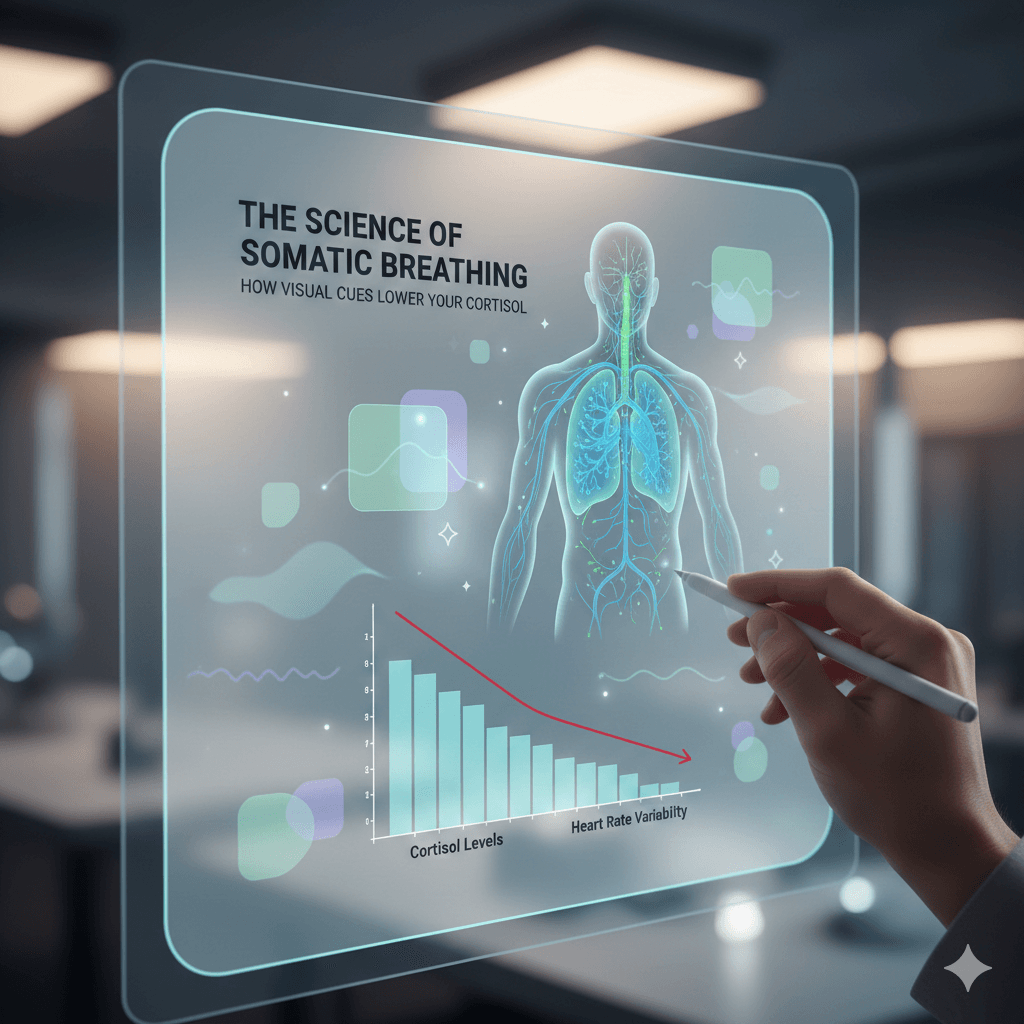
The Science of Somatic Breathing: How Visual Cues Lower Your Cortisol
Somatic breathing paired with slow visual cues helps regulate the nervous system and lower cortisol naturally. Discover the science behind how guided breath and rhythmic imagery activate the vagus nerve, reduce stress hormones, and restore calm in just minutes.
Muhammad Haroon
Author
Expert Reviewed
Medically reviewed by Muhammad Haroon, B.Sc. Applied Psychology
What Is Somatic Breathing?
“Somatic” comes from the Greek word soma, meaning body. Somatic breathing focuses on internal body awareness rather than forcing a breathing pattern.
Unlike rigid breathwork techniques, somatic breathing emphasizes:
- Sensory awareness
- Slow, diaphragmatic breathing
- Gentle attention to bodily sensations
- Safety signals to the nervous system
It’s less about “doing it right” and more about feeling your body shift.
Cortisol and the Stress Response
When your brain perceives a threat, the amygdala activates your fight-or-flight response. This signals the hypothalamus to trigger the adrenal glands, which release cortisol.
This process is governed by the HPA axis (hypothalamic-pituitary-adrenal axis).
Short-term, this is helpful. Long-term, elevated cortisol can:
- Suppress immune function
- Increase inflammation
- Disrupt sleep cycles
- Impair digestion
- Reduce emotional regulation
To lower cortisol, we must signal to the brain: “You are safe.”
The Role of the Vagus Nerve
The key to turning off the stress response lies in the parasympathetic nervous system — particularly the vagus nerve.
When activated, the vagus nerve:
- Slows heart rate
- Reduces blood pressure
- Improves digestion
- Lowers cortisol production
Slow, diaphragmatic breathing stimulates this nerve mechanically through pressure changes in the thoracic cavity.
But here’s where visual cues amplify the effect.
Why Visual Cues Matter
Your nervous system constantly scans your environment for safety or danger — a process called neuroception.
Visual signals can either:
- Heighten stress (crowded inbox, clutter, bright screens), or
- Promote calm (soft movement, predictable rhythms, nature imagery)
Research in environmental psychology shows that slow, rhythmic visual patterns can:
- Reduce sympathetic nervous system activation
- Improve heart rate variability (HRV)
- Increase parasympathetic tone
When paired with breath, visual cues create dual-channel regulation — the eyes and lungs send safety signals simultaneously.
How Visual Breathing Guides Lower Cortisol
Here’s what happens physiologically:
- You follow a slow-moving visual (like an expanding circle).
- Your breathing synchronizes to that rhythm.
- Exhalations lengthen naturally.
- Vagus nerve activation increases.
- Heart rate variability improves.
- Cortisol output decreases over time.
Longer exhalations are especially powerful because they enhance parasympathetic dominance.
In simple terms:
Slow eyes + slow breath = safe body.
The Brain-Body Feedback Loop
Breathing isn’t just automatic — it’s one of the few bodily systems you can consciously influence.
When you slow your breath:
- Carbon dioxide levels stabilize
- The brainstem adjusts arousal levels
- The prefrontal cortex regains control over the stress response
This shifts you from reactive mode to regulated mode.
And when visual rhythm supports that process, the effect becomes more sustainable and easier to maintain.
A Simple 3-Minute Somatic Visual Breathing Practice
Try this:
- Sit comfortably with your spine supported.
- Look at a slow-moving visual (like a gently expanding and contracting shape).
- Inhale as it expands for 4 seconds.
- Pause briefly.
- Exhale slowly for 6 seconds as it contracts.
- Notice sensations in your chest, ribs, and abdomen.
- Repeat for 3 minutes.
Focus on softening your gaze rather than staring intensely.
After a few minutes, you may notice:
- Shoulders dropping
- Jaw unclenching
- Slower thoughts
- A feeling of groundedness
That’s your nervous system recalibrating.
Why This Works Better Than “Just Relax”
Telling someone to relax doesn’t change their physiology.
But changing:
- Breath rhythm
- Visual input
- Sensory awareness
Directly influences the autonomic nervous system.
Somatic breathing works because it speaks the language of the body — rhythm, sensation, and safety.
The Long-Term Impact
Practiced consistently, somatic visual breathing can:
- Lower baseline cortisol levels
- Improve sleep quality
- Increase emotional resilience
- Reduce anxiety symptoms
- Improve focus and clarity
It’s not about eliminating stress — it’s about recovering from it faster.
Final Thoughts
Cortisol isn’t the enemy. Chronic dysregulation is.
Somatic breathing with visual cues offers a biologically intelligent way to calm the stress response. By engaging both your breath and your eyes, you create a powerful feedback loop that tells your body:
You are safe.
You can slow down.
You can reset.
And in a world that constantly pulls your attention outward, that inward reset might be the most powerful tool you have.